
In the previous article, the pollination of flowering plants (angiosperms) was explained. Pollination, however, is just the first step in producing seeds.
Fertilisation
Fertilisation must have been completed for seed production. When the pollen attaches to the stigma, the fertilisation process starts.
Pollen tube from pollen grain
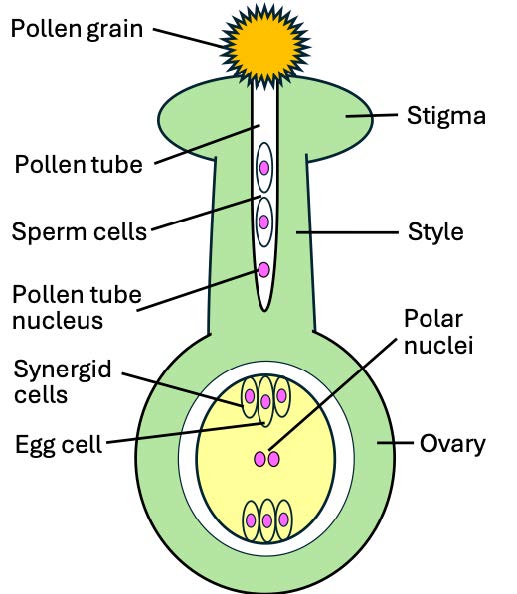
As soon as a pollen grain attaches to the head of a stigma, a pollen tube containing a pollen tube nucleus and a sperm cell elongates into the style
(Fig. 1). At this stage, a sperm cell divides into two cells. Therefore, the pollen tube contains one pollen tube nucleus and two sperm cells. The pollen tube nucleus navigates the pollen tube to a synergid cell.
Production of embryo
Synergid cells next to the egg cell emit a hormone to lure the pollen tube.
When the pollen tube reaches the synergid cell, it destroys the cell and
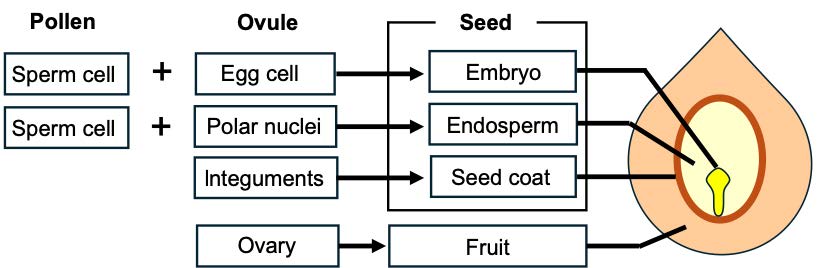
reaches the egg cell. Then one of the sperm cells and the egg cell fertilise,
and it becomes an embryo (Fig. 2). The embryo is a primordial plant that will
develop into a plant after germination of the seed.
Production of endosperm
The other sperm cell fertilises with two polar nuclei in the ovule, becoming
an endosperm that is the nutrition for seed germination. Seeds containing
the endosperm are called “endospermic seeds,” such as wheat and corn.
However, not all plant seeds have an endosperm. The seeds lacking the endosperm are called “non-endospermic seeds”, such as peas and orchids.
Peas, for example, contain nutrition in the cotyledons for seed germination.
Such plants absorb nutrition from the endosperm into the cotyledons while
the seeds are developing, and the endosperm disappears. Orchid seeds
absorb fungi as nutrition for germination, as the seeds do not have
nutrition.
Formations of other organs
Integuments in the ovule become the seed coat. The ovary surrounding the
ovule becomes the fruit (Fig. 2).