On Friday, the wind got up, whirling a blizzard of leaves and sending us into a mild panic.
“This isn’t normal. Is it climate change?” “Has autumn arrived too early?”
“Why are the leaves so yellow and falling off the trees in our street, and covering the road with a yellow carpet?” “It’s only June.”
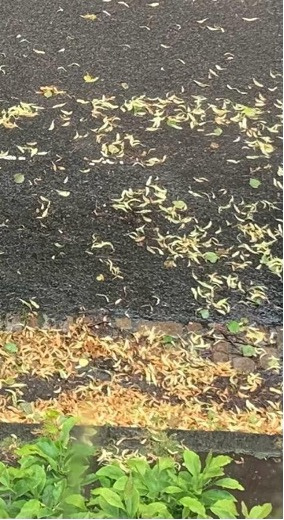
So mused our neighbours and ourselves the other day as we stood gossiping in our now yellow-carpeted street, busy catastrophising about the state of the world.
“You must know!” Perhaps, being a garden guide, I should have.
“I think they’re bracts,” I said.
“You are making that up,” said partner. “That’s not a word.”
Stately lime trees are planted up and down my street. They loom tall and throw shade on our front gardens. During winter storms their branches lurch rather too close to our windows and chimneys. They also cover parked cars with a sticky mess, a honeydew made by masses of aphids feeding on the leaves.
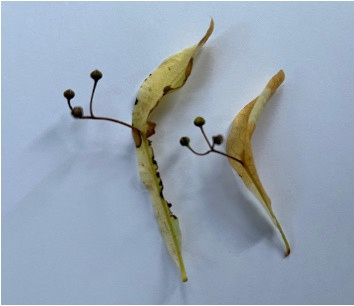
But back to the bracts– not leaves at all. Well, they are, but they are special leaves. On my journey towards tree awareness, I learn something new every day. After a short google I was able to confidently reassure everyone about the perfectly natural and expected phenomenon of these specialised modified leaves which twirl down at this time of year, attached to a few seeds, dispersing the seeds in the wind.
Panic over. Everyone can settle down.
‘Lime flowers and fruit are always attached to a pale green, odd-shaped leaf called a bract.’ So says Tree Guide UK.
The word ‘lime’, by the way, as used for the trees in the UK, is believed to come from the Old English word lind, and, as you know, has absolutely nothing to do with the fruit floating in your gin and tonic.
There are around 30 species of lime. Common lime, Tilia x europaea, is the most commonly planted lime tree in cities. Itis a hybrid of Tilia cordata (‘cordata’ meaning ‘heart-shaped’) and Tilia platyphyllos (‘platyphyllos’ meaning ‘with broad leaves’).
A final word on bracts: did you know that your Christmas poinsettia has – not bright red flowers, but… bracts?