
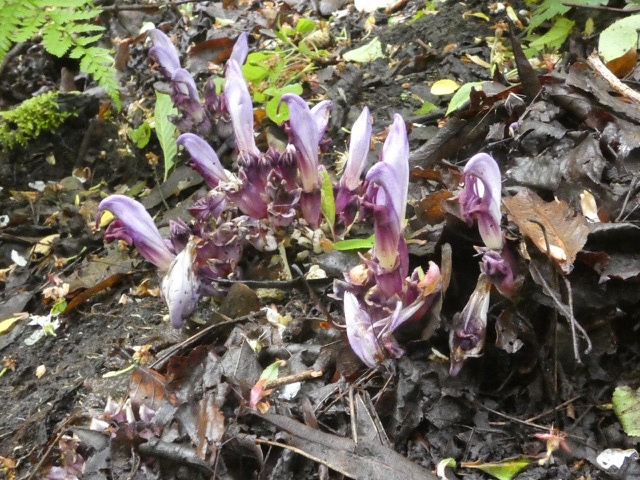
Great credit goes to Heather Buchan, one of our gardeners, for her observational and photographic skills as well as horticultural knowledge and skills in spotting this plant.
Lathraea clandestina or purple toothwort is a rare plant.
This specimen was spotted by Heather in an area of the Gardens that is inaccessible to the public and in any case difficult to access being nowhere near walkways.
I was grateful to be shown the plant in flower. It is a member of the Orobanchaceae family and is parasitic. It catches the eye from a few yards away as it looks like a clump of crocuses but at the wrong time of year!
The purple flowers are 2-3 inches in height. There are no leaves or green parts no chlorophyll and therefore no photosynthesis. The mature fruits produce about 5 seeds which get fired up to seven metres in distance. The flowering period is from April to early June thereafter it disappears under the earth until the next flowers appear.
The seeds take up to 10 years from maturing to flowering. It is typically found growing in close association with willows, poplars and hazels often in semi-shade in a damp environment close to water. The plant does no harm to its host and relies on the host for nutrition via the roots of both plants.
It is native to mid and southern France, Italy and some parts of Spain where it is rare. It is rare in UK and especially in Scotland. It is assumed that is arrived in non native areas on logs and nursery specimens. Old woodland gardens are its domain in the UK. Edinburgh Botanics has several clumps particularly around the large pond close to willows and poplars.
There is no record of how or when purple toothwort arrived in Edinburgh Botanics. It is quite likely that there are other clumps in our Gardens and in future spreading clumps may be more visible to visitors.